Return on Marketing Investment (ROMI)
ROMI measures the efficiency of your marketing spend:
ROMI = (Revenue Generated − Marketing Cost) / Marketing Cost
Lucia makes the "Revenue Generated" side trustworthy by crediting revenue to the campaign that earned it — matching web2 signals (clicks) to web3 outcomes (on-chain conversions) — instead of handing it to the last click.
Feed ROMI the right data
- Send conversion values — include an
amounton everytrackConversionso revenue is real, not a count. See Track Conversion. - Attribute costs by channel — connect your ad platforms so spend lines up against the conversions each channel actually drove.
Read it back
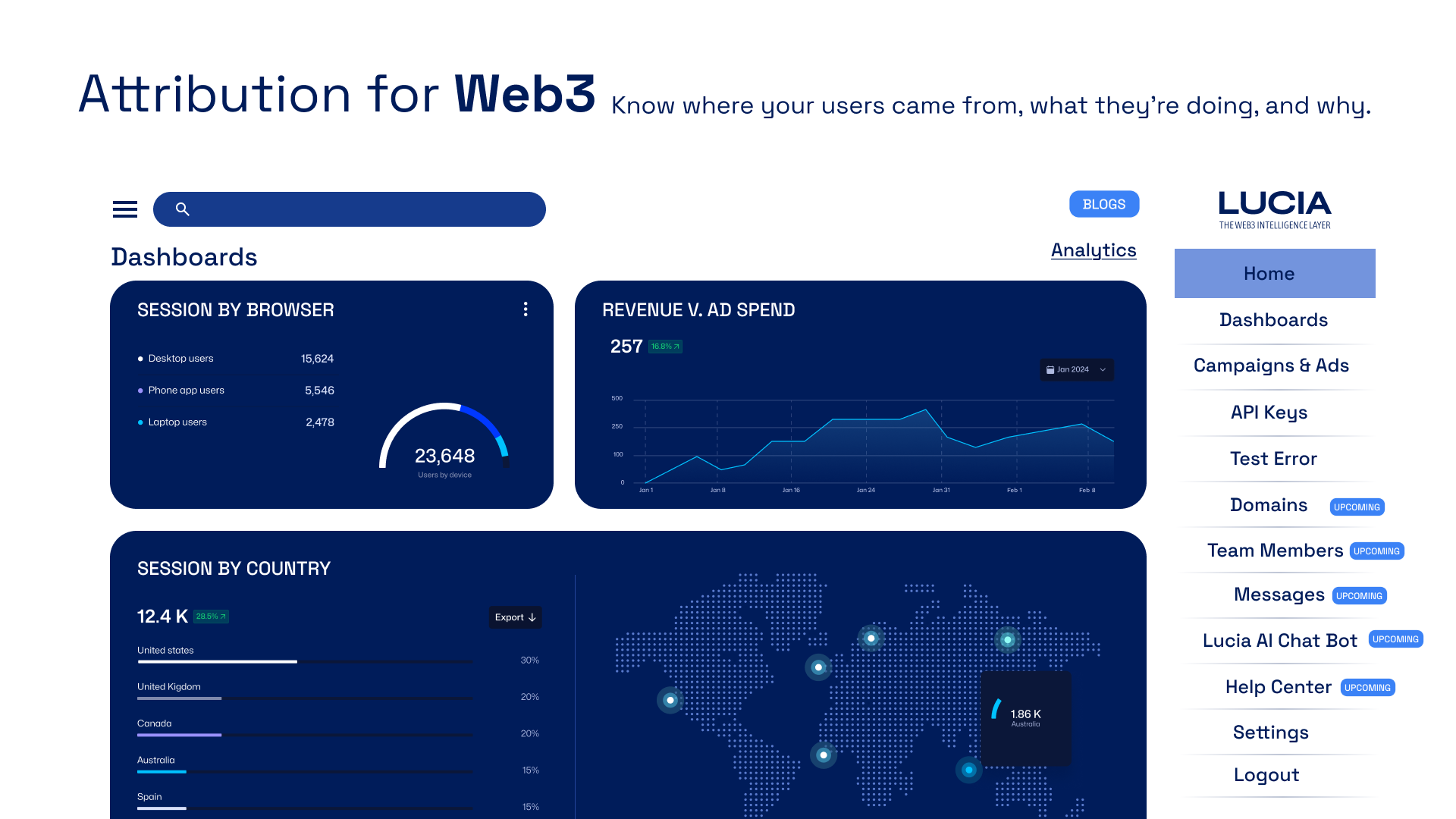
Lucia computes the metrics ROMI depends on per channel and campaign:
- CAC, ROAS, and LTV by channel, campaign, cohort, and region.
- Conversion rate measured in people — the share of visitors who clicked a link and went on to convert — not inflated session counts.
These are in the dashboard and the Attribution API, and can be exported to your own BI/warehouse.
Best practices
- Monitor by channel — watch CAC, LTV, and ROI per channel; flag the underperformers.
- Reallocate on evidence — shift budget toward the sources attribution shows convert, not the ones last-click flatters.
- Compare cohorts — organic referrals and paid clicks often have very different LTV; judge them on lifetime value, not first purchase.
Illustrative example: an exchange improved ROMI by reallocating budget away from paid ads that looked good in last-click reports toward the channels attribution showed were actually converting.